
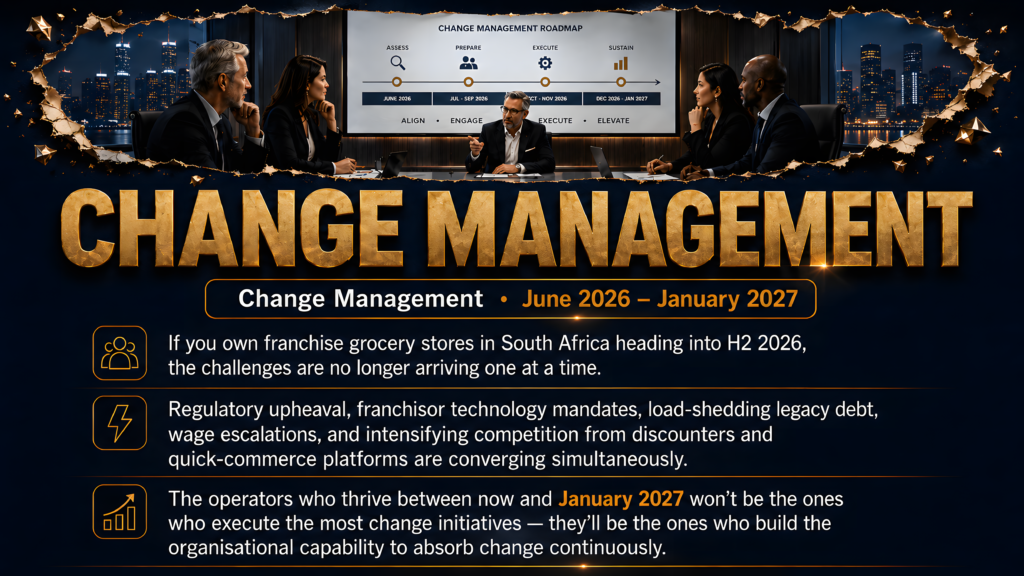
Change Management for SA Grocery & FMCG Franchisee Owners
A real-world guide to every pain point hitting franchise store owners from June 2026 through January 2027 — and the proven solutions smart operators are deploying right now.
📅 June 2026 – January 2027 | South AfricaIf you own one or more franchise grocery stores in South Africa heading into the second half of 2026, you are navigating the most concentrated wave of change the sector has ever experienced.
Regulatory upheaval, technology mandates from your franchisor, load-shedding legacy costs, wage bill escalations, shifting consumer behaviour, supply-chain restructuring, and intensifying competition from discounters and quick-commerce players are all converging simultaneously.
This page walks through 15 major pain points — each grounded in what is actually happening on the ground — and maps the specific change-management solutions that the best-performing franchisee operators in South Africa are implementing.
🔌 Load-Shedding Legacy & Energy Transition Costs
Although Eskom’s grid has stabilised compared to 2023-24, the municipal infrastructure remains unreliable in many metros. Franchisees who invested heavily in generators and solar during the crisis are now carrying R500k–R3m in debt or lease obligations on energy infrastructure. Meanwhile, franchisors are mandating energy-efficiency upgrades (LED refrigeration, inverter-driven compressors) that require further capital.
🔴 The Real Pain Points Critical
- Stranded assets: Diesel generators purchased at premium prices during peak load-shedding are now oversized, underutilised, and depreciating fast — yet lease payments continue.
- Double capital burden: Franchisors demand solar + battery retrofits while stores are still paying off generator installations.
- Staff uncertainty: Energy-management roles created during load-shedding (generator operators, fuel monitors) now face redundancy — creating labour-relations tension.
- Inconsistent municipal billing: Stores running hybrid (grid + solar + genset) systems receive wildly inaccurate municipal electricity bills, consuming management time in disputes.
- Cold-chain compliance pressure: Franchisor and FSQA auditors now require continuous digital temperature logging with battery backup — another system to install and manage.
✅ How Smart Operators Solve This
- Energy audit first, spend second: Commission a store-specific energy audit (R15k–R25k) before committing to any franchisor-mandated upgrade. Smart operators use the audit to negotiate phased compliance timelines with their franchisor’s property/operations team.
- Generator monetisation: Negotiate with the franchisor to redeploy oversized generators to newer stores in the group, or sell into the still-active secondary market in East Africa and rural SA municipalities.
- Solar PPA model: Instead of buying solar outright, contract a third-party Power Purchase Agreement (PPA) provider — zero capex, predictable per-kWh cost. Companies like Sola Group, SolarAfrica, and Rubicon offer retail-specific PPAs.
- Reskill, don’t retrench: Retrain generator operators into energy-management and cold-chain compliance roles — they already understand the equipment. This avoids CCMA risk and maintains institutional knowledge.
- Centralised energy dashboard: Deploy a cloud-based energy monitoring platform (e.g., GridWatch, CarbonTracker SA) across all stores. One dashboard for solar output, grid draw, genset runtime, and municipal billing verification. Assign one person across the group to manage energy billing disputes.
- Franchisor negotiation leverage: Present your energy audit and PPA proposal to the franchisor as a business case — show them the TCO (total cost of ownership) is lower than their default mandate. Smart franchisees form informal owner forums to negotiate collectively.
📋 Franchisor-Mandated Technology & System Upgrades
Major SA grocery franchisors — Shoprite/Checkers (via their franchise models), Pick n Pay (franchise conversions post-restructure), SPAR, and Boxer — are all in various stages of ERP migrations, POS system replacements, loyalty platform integrations, and AI-driven planogram compliance. Franchisees are expected to implement these changes on franchisor timelines, often with limited support and at their own cost.
🔴 The Real Pain Points Critical
- Forced POS migration: New POS systems (e.g., SPAR’s IT2 rollout, PnP’s Oracle-based refresh) require hardware replacement, staff retraining, and weeks of parallel running — all during trading hours.
- Data migration nightmares: Historical sales data, supplier price files, and loyalty customer records don’t transfer cleanly. Franchisees lose visibility of trading patterns during the transition window.
- Staff resistance: Till operators, receiving clerks, and floor staff who mastered the old system over years actively resist new systems — productivity drops 20–40% for 4–8 weeks post-go-live.
- Connectivity dependency: New cloud-based systems require reliable broadband. Many township and rural franchise locations have intermittent connectivity — yet the franchisor’s system has no robust offline mode.
- Cost ambiguity: Franchisors often quote the software licence cost but not the full implementation cost — cabling, hardware, IT contractor time, overtime for parallel-run staffing, and the opportunity cost of management distraction.
- Multi-store sequencing: Owners with 3–5 stores must decide the rollout sequence, knowing that each store disruption pulls management attention from the others.
✅ How Smart Operators Solve This
- Demand a full-cost disclosure from the franchisor: Before committing to timelines, request a written total implementation cost estimate including hardware, cabling, IT support, training hours, and expected productivity-loss period. Get it in writing.
- Pilot your weakest store first: Counter-intuitively, smart operators pilot the new system at their lowest-volume store — the financial risk of disruption is lowest, and the lessons learned protect high-revenue sites.
- “Super user” strategy: Identify 2–3 high-performing, tech-comfortable staff members per store. Train them first (even sending them to the franchisor’s training centre). They become your in-store change champions and peer trainers. Pay them a temporary R500–R1,000/month uplift during rollout.
- Dual connectivity: Install a secondary fibre or LTE failover line (R500–R1,500/month) at every store before go-live. Negotiate this as a franchisor co-funded cost since their system requires it.
- Parallel-run protocol: Run old and new systems simultaneously for minimum 2 weeks. Yes, it’s double the work — but it catches data-migration errors before they hit your P&L. Budget for overtime.
- Extract your data before migration: Export all historical sales, margin, and shrinkage data from the old system into Excel/CSV before the old system is decommissioned. Smart operators keep 3 years of data independently — never rely solely on the franchisor’s archive.
- Franchisor accountability SLA: Negotiate a service-level agreement for post-go-live support: response time for system outages, on-site IT support availability, and financial compensation if system downtime exceeds agreed thresholds.
👥 Labour Law Changes & National Minimum Wage Increases
The National Minimum Wage is set to increase again in 2026, building on successive above-inflation adjustments. Combined with amendments to the Basic Conditions of Employment Act, tighter regulation of labour brokers and TES (temporary employment services), and growing union militancy in the retail sector (particularly SACCAWU), franchisee owners face a significantly higher and more complex wage bill.
🔴 The Real Pain Points Critical
- Wage bill up 8–12% year-on-year: When your net margin is 3–5%, a wage increase that outstrips sales growth is existential. Franchisees can’t increase prices independently (pricing is franchisor-controlled), so the cost is fully absorbed.
- Compression effect: When the minimum wage rises, every tier above it expects proportional increases. Your supervisors, department managers, and skilled butchery/bakery staff demand adjustments — or they leave.
- Scheduling complexity: New regulations around maximum working hours, Sunday/public holiday premiums, and mandatory rest periods make scheduling exponentially harder for stores that trade 18–24 hours.
- TES/casual worker restrictions: Tighter rules on when you can use temporary or part-time workers force premature conversion to permanent positions — with full benefits, leave accrual, and UIF/SDL obligations.
- CCMA exposure: Any restructuring, role change, or schedule modification triggered by change management must follow strict Section 189/189A processes. A single procedural error can result in R50k–R200k in CCMA awards or settlements.
- Staff poaching: Competitors (especially new-format discounters) aggressively recruit trained staff, particularly in fresh departments. Your training investment walks out the door.
✅ How Smart Operators Solve This
- Labour-cost modelling before compliance: Build a detailed 12-month labour-cost model that maps every employee, their current wage, the mandated increase, compression adjustments, UIF/SDL impact, and overtime patterns. Know the exact Rand impact before it hits.
- Productivity-linked incentive structures: Negotiate with staff (and unions where applicable) to link a portion of increases to measurable productivity — units packed per hour, till scan rates, shrinkage reduction. This aligns the wage increase with value creation.
- Smart scheduling software: Deploy workforce management tools (e.g., Workforce Software, Deputy, or locally developed Planday) that optimise schedules against trading patterns, auto-apply BCEA rules, and flag compliance risks. The R2k–R5k/month cost per store pays for itself in avoided overtime and CCMA exposure.
- Cross-training and multi-skilling: Train every floor employee in at least 2 departments. This allows leaner scheduling without compromising service — a bakery assistant who can work the deli counter during peak reduces headcount requirements.
- Retain with non-wage benefits: Smart operators combat poaching with loyalty mechanisms that cost less than wage increases: staff shopping discounts (5–10% on store purchases), transport allowances, cellphone airtime, study bursaries, and annual profit-share bonuses.
- Proactive CCMA preparation: Retain a labour attorney on a monthly retainer (R3k–R8k/month) rather than paying crisis rates (R2,500/hour). Have all employment contracts, scheduling policies, and disciplinary codes reviewed and updated before any change process begins.
- Engage SACCAWU early: If your store is unionised, initiate proactive quarterly engagements with the shop steward — not just when you need something. Operators who build relationships during calm periods face dramatically less resistance during change.
📊 Consumer Down-Trading & Basket Shrinkage
Despite modest interest rate reductions, the SA consumer remains under severe pressure. Food inflation is sticky at 6–8%, real wage growth is negative for most households, and the middle-income segment continues to shrink. Consumers are aggressively down-trading from brands to private label, reducing basket sizes, shopping more frequently for smaller amounts, and switching between retailers based purely on promotions.
🔴 The Real Pain Points High
- Average basket value declining: Even though foot traffic may be stable, the average transaction value is dropping 3–8% year-on-year in real terms. Customers buy 15 items instead of 20.
- Private label pressure: Customers demand private-label options, but franchisees have limited control over private-label range and pricing — that’s a franchisor decision. If your franchisor’s PL range is weak, you lose customers to competitors.
- Promo dependency: Sales are increasingly driven by deep-cut promotions. But promotional stock often arrives late, in wrong quantities, or with insufficient margin for the franchisee. The franchisor negotiates the deal; you carry the execution risk.
- Category mix shift: Customers cut discretionary categories (snacks, beverages, personal care) and concentrate on staples. This shifts your sales mix toward lower-margin products, eroding gross profit even if turnover holds.
- Informal competition: Spaza shops, now increasingly formalised and supplied by sophisticated wholesalers, are capturing convenience-driven basket spend in township and peri-urban areas.
✅ How Smart Operators Solve This
- Hyper-local range tailoring: Use your POS data to identify the top 200 SKUs by store — not by group. Petition your franchisor for range flexibility on the bottom 10–15% of shelf space to stock locally relevant products that your specific community demands.
- Fresh department as differentiator: Invest disproportionately in fresh produce, bakery, and butchery — these are the categories where you have pricing autonomy, where quality variation drives loyalty, and where spazas and discounters can’t compete. Smart operators run fresh at 35–45% of store mix.
- Basket-building promotions: Instead of deep single-item cuts, design bundle deals (“Braai Pack: 1kg wors + 6-pack rolls + 1L sauce = R89.99”). These increase items per basket and protect overall margin better than single-item loss leaders.
- Loyalty program activation: If your franchisor has a loyalty program (SPAR Rewards, Smart Shopper, Xtra Savings), actively use the data. Identify lapsed customers and send targeted offers. Operators who actively work loyalty data see 5–8% higher retention.
- Community anchoring: Become indispensable to the community — ATM in-store, money transfer services, utility prepaid, community notice boards, local supplier partnerships. The more reasons people have to visit, the more basket opportunities you create.
- Price perception management: You don’t need to be cheapest on everything — you need to be cheapest on the 20 items customers use as mental benchmarks (bread, milk, maize meal, cooking oil, eggs). Know your competitor pricing on these items weekly and match aggressively.
🚛 Supply Chain Disruption & Supplier Consolidation
The SA FMCG supply chain is undergoing significant consolidation. Major distributors are merging, FMCG manufacturers are reducing direct-store-delivery (DSD) and pushing through centralised DCs, and the Transnet port and rail crisis continues to create cost escalations on imported goods. Franchisees are caught between franchisor-mandated supply chains and local supplier relationships.
🔴 The Real Pain Points High
- Out-of-stocks on key lines: Centralised DC models mean you can’t simply phone a rep and get emergency stock. When the DC is out, you’re out — and customers go next door.
- Delivery window failures: Trucks arrive outside scheduled windows (often 2–4 hours late), forcing unplanned overtime for receiving staff and disrupting floor operations.
- Forced supplier changes: Franchisors delist suppliers or change preferred brands without adequate transition periods. Your customers notice when “their” brand disappears and blame you, not the franchisor.
- Import cost pass-through: Port inefficiencies and Rand volatility mean landed costs on imported products (tinned goods, cleaning products, certain dairy inputs) spike unpredictably. The franchisor’s cost price changes often lag, leaving you selling at thin or negative margins for weeks.
- Local supplier squeeze: Small local suppliers (fresh produce farmers, local bakeries, craft producers) that differentiate your store are being squeezed out by franchisor centralisation policies.
✅ How Smart Operators Solve This
- Safety stock discipline: On your top 50 SKUs by revenue, maintain 3–5 days of safety stock beyond normal par levels. Yes, this ties up working capital — model the cost of a stockout (lost sales + customer defection) against the carrying cost. The stockout is always more expensive.
- Receiving-bay excellence: Implement a strict receiving protocol — temperature checks, quantity verification, expiry date checks, delivery-time logging. Smart operators photograph every delivery note and log arrival times. This data becomes leverage in service-level negotiations with the franchisor DC.
- Escalation protocol with the franchisor: Don’t just complain informally. Document every out-of-stock incident, every late delivery, every quality issue. Submit formal monthly performance reports to your franchisor’s supply chain manager. The operators who do this consistently get prioritised.
- Approved local supplier network: Work within the franchisor’s frameworks to get local suppliers approved. Prepare the business case: “This local farm delivers fresher produce, 2 days/week, at 8% lower cost than the DC, with zero food-miles marketing value.” Most franchisors have a local-supplier approval process — use it.
- Cross-docking with peer franchisees: In some franchise groups, store owners can transfer stock between stores. Build relationships with nearby franchisees for emergency stock sharing — one call can prevent a weekend stockout on a R200k line.
- Demand forecasting investment: Even basic demand forecasting (using 12-month POS history + event calendar + weather data) dramatically improves ordering accuracy. Some franchise POS systems offer this natively — if yours doesn’t, a simple Excel model updated weekly outperforms gut-feel ordering.
🔒 Crime, Shrinkage & Security Cost Escalation
Retail crime in South Africa remains at crisis levels. Organised retail crime syndicates target grocery stores for high-value products (baby formula, spirits, cosmetics, protein). Internal shrinkage (staff theft) accounts for 40–60% of total shrinkage in most stores. Armed robbery, ram-raids on ATMs, and cash-in-transit hijackings remain prevalent. Security costs now represent 2–4% of turnover for many franchisees.
🔴 The Real Pain Points Critical
- Shrinkage running at 2–4% of turnover: At an average 3.5% net margin, shrinkage at 3% means you’re working for almost nothing. Every R1 of shrinkage requires R25–R30 of additional sales to recover.
- Security cost spiral: Armed guards, CCTV systems, alarm monitoring, cash management services, EAS (electronic article surveillance) tags — the combined monthly cost can exceed R80k–R150k per store.
- Staff complicity: Internal theft often involves collusion between staff and external parties. Detecting and proving this is complex, time-consuming, and emotionally draining for the owner.
- Insurance premium increases: Following claims, insurance premiums spike 20–40%. Some insurers are withdrawing from high-risk retail locations entirely.
- Staff trauma and turnover: After armed robbery incidents, staff experience trauma, increased absenteeism, and higher turnover — a hidden cost that rarely appears in the P&L but devastates operational performance.
- Change fatigue around security protocols: Staff are tired of new security procedures — bag checks, locker policies, biometric access, till-point cash limits. Each new rule generates resistance.
✅ How Smart Operators Solve This
- AI-powered CCTV analytics: Replace passive CCTV monitoring with AI-driven systems (e.g., iOmniscient, Rhombus, or local providers like Vumacam) that automatically flag suspicious behaviour patterns — sweethearting at tills, unusual movement in high-value aisles, after-hours access. The monthly uplift (R3k–R8k/store) pays for itself within the first quarter.
- Exception-based reporting (EBR) on POS: Implement or activate EBR software that flags anomalous till transactions — excessive voids, no-sales, discount overrides, under-rings, and refunds. Cross-reference with CCTV timestamps. This is the single most effective internal-theft detection tool available.
- Cash reduction strategy: Accelerate the shift to cashless transactions — tap-to-pay, QR codes (SnapScan, Zapper, MasterPass), and app-based payments. Every R1 removed from cash handling reduces robbery risk, cash-handling costs, and cash shrinkage. Target 70%+ cashless by January 2027.
- Community intelligence network: Smart operators build relationships with neighbouring businesses, community policing forums (CPFs), and local SAPS station commanders. Early warning of crime patterns in the area allows preemptive action.
- Trauma support protocol: Pre-arrange a trauma counselling provider (many EAP providers offer this affordably). After any violent incident, provide immediate and follow-up counselling. Staff who feel cared for recover faster and remain loyal.
- Shrinkage accountability by department: Make department managers accountable for their department’s shrinkage — with both consequences and rewards. When butchery knows their shrinkage number and has a quarterly target, behaviour changes.
- Insurance risk mitigation file: Maintain a comprehensive “risk file” — updated security assessments, CCTV footage retention logs, incident reports, security company SLAs. Present this proactively to insurers at renewal. Operators who do this negotiate 10–15% lower premiums.
📱 Digital Commerce, Quick-Commerce & Omnichannel Pressure
Online grocery is growing 25–30% YoY in SA. Checkers Sixty60, Woolworths Dash, Pick n Pay asap!, and third-party platforms like Mr D Food and Uber Eats are now handling significant grocery volumes. Quick-commerce (delivery in 30–60 minutes) is reshaping urban consumer expectations. Franchisees are caught between participating (and paying commissions/tech fees) and losing customers to operators who do.
🔴 The Real Pain Points High
- Commission erosion: Third-party delivery platforms charge 15–25% commission. On a 3–5% net margin, every delivery order is a loss leader unless managed carefully.
- In-store picking disruption: Online orders picked from store shelves disrupt the shopping experience for walk-in customers — pickers blocking aisles, depleting shelf stock of promoted items, and creating friction at tills.
- Fulfilment accuracy: Picking errors (wrong items, short-dated stock, substitutions) generate customer complaints that the platform attributes to your store — damaging your ratings and order volumes.
- Staff skills gap: In-store pickers need different skills than traditional floor staff — speed, accuracy, app literacy, customer communication for substitutions. This requires dedicated recruitment and training.
- Channel cannibalisation: Is the online order a new customer, or is it your existing walk-in customer now ordering from their couch — but you’re paying 20% commission for the privilege?
- Franchisor’s own platform conflicts: Some franchisors operate their own e-commerce platform that sources from your store but controls the customer relationship, data, and pricing. You become a fulfilment warehouse for your own franchisor.
✅ How Smart Operators Solve This
- Dedicated dark-store area: If online volume exceeds 30 orders/day, carve out a dedicated picking area (even 20m²) with high-velocity online SKUs pre-staged. This eliminates aisle congestion and improves pick accuracy from 85% to 97%+.
- Selective platform participation: Not all platforms are equal. Analyse your commission rate, average order value, and new customer acquisition per platform. Smart operators often focus on 1–2 platforms rather than being on all of them thinly.
- Own-delivery for high-value customers: For loyal customers with large basket sizes, offer direct delivery (using a bakkie and a trusted driver) — bypassing platform commissions entirely. Even a WhatsApp-based ordering system with a R40 delivery fee is profitable above R500 basket value.
- Upskill pickers, don’t just hire: Select your fastest, most detail-oriented floor staff for picker roles. Give them picking-speed targets and accuracy bonuses. Top pickers can handle 8–12 orders/hour — poor pickers manage 3–4.
- Data ownership negotiation: When your franchisor operates the e-commerce platform, insist on access to your store’s customer data. You need to know who’s ordering, what they’re buying, and how often. This is your customer — you funded the acquisition through your inventory and fulfilment.
- Click-and-collect promotion: Push click-and-collect over delivery. The customer orders online, picks up in-store — you save on delivery cost, and 60% of click-and-collect customers buy an additional 2–3 items when they walk in. This is the best of both worlds.
🏗️ Store Refurbishment & Format Change Mandates
Franchise groups are aggressively rolling out new store formats — SPAR’s community market concept, Pick n Pay’s post-restructure “value” format, Shoprite’s revised Checkers Hyper layout. Franchisees are required to refurbish to the new brand standard, often within tight timelines, at costs of R2m–R15m per store depending on size and scope.
🔴 The Real Pain Points High
- Trading disruption during refurb: A full refurbishment typically takes 8–16 weeks, during which sales drop 30–60%. Even phased refurbishments cause significant customer inconvenience and staff disruption.
- Capital access: Accessing R5m+ in capital during a period of compressed margins is extremely difficult. Bank financing terms have tightened, and franchisors often don’t provide direct funding — only “preferred contractor” lists.
- Scope creep: What starts as a cosmetic refresh often becomes a full infrastructure overhaul once walls are opened — electrical compliance issues, refrigeration pipe degradation, structural problems. Costs can escalate 30–50% beyond the initial quote.
- Staff morale and retention during refurb: Reduced hours, noise, disrupted routines, and uncertainty about “whether the store is closing” create anxiety and increase turnover during the refurbishment period.
- Post-refurb customer re-acquisition: Customers who found alternatives during refurb don’t automatically return. Smart operators know it takes 8–12 weeks post-refurb to rebuild foot traffic to pre-refurb levels.
✅ How Smart Operators Solve This
- Negotiate a franchisor contribution: Many franchisors have refurbishment incentive schemes — reduced fees, co-funded fixtures, marketing support. But they don’t always volunteer this. Ask explicitly for the full menu of available support before you commit.
- Night-work phased refurbishment: The most successful refurbs are done in phases with construction happening from 10pm–6am. The store trades during the day (with reduced area) and transforms overnight. Costs are 15–20% higher due to night-work premiums — but sales preservation far outweighs this.
- Pre-refurb communication blitz: Inform customers 6 weeks before refurb starts — signage, WhatsApp broadcast, social media. The message: “We’re upgrading for you. We’ll stay open. Bear with us. Here’s what’s coming.” Post a weekly progress update with photos. Customers who feel included become advocates rather than defectors.
- Staff engagement during refurb: Involve department managers in the layout design. Show them the new planograms. Let them visit a recently refurbished store in the group. When staff feel ownership of the new format, they become its best ambassadors.
- Grand re-opening event: Budget R30k–R80k for a genuine re-opening event — local celebrity or influencer, live music, deep-cut promotions, free samples, lucky draws. The re-opening must feel like a new beginning, not just “we took the scaffolding down.”
- Contingency budget of 25%: Add 25% to every refurbishment quote as contingency. Scope creep is not a risk — it’s a certainty. The operators who budget for it avoid the financial panic when the electrician finds non-compliant wiring behind the deli counter.
📜 Regulatory & Compliance Avalanche
The regulatory burden on SA grocery retailers is intensifying from multiple directions: POPIA enforcement (now actively penalised), Health Promotion Levy (sugar tax) expansions, new front-of-pack nutritional labelling regulations, Extended Producer Responsibility (EPR) levies on packaging, B-BBEE scorecard requirements for franchise renewals, and municipal by-law compliance on waste, signage, and trading hours.
🔴 The Real Pain Points Medium-High
- Compliance cost is a hidden tax: The direct cost of compliance consultants, auditors, system modifications, and training is R100k–R300k/year per store — rarely budgeted for accurately.
- POPIA risk: Every loyalty card, delivery address, staff record, and CCTV recording is personal information under POPIA. A data breach or complaint to the Information Regulator can result in fines up to R10 million.
- Labelling changes: New front-of-pack warning labels on high-sugar, high-sodium, and high-fat products require shelf-talker updates, promotional material changes, and staff training on customer questions.
- EPR levy confusion: Extended Producer Responsibility levies on packaging are complex — who pays? The manufacturer? The retailer? The franchisee? Responsibility often falls through the cracks and arrives as an unexpected cost.
- B-BBEE scorecard pressure: Franchise renewal may depend on maintaining a Level 4 or better B-BBEE rating. Enterprise development, supplier development, and skills development contributions add to costs — but are also opportunities if structured correctly.
- Municipal compliance variation: Regulations differ by municipality. A franchisee with stores in three different municipalities may face three different sets of by-laws on waste management, signage, and liquor licensing.
✅ How Smart Operators Solve This
- Compliance calendar: Create a 12-month compliance calendar with every regulatory deadline, audit date, licence renewal, and filing requirement. Assign each item to a specific person with a 30-day advance alert. A R5,000 administrative fine for a missed licence renewal is pure waste.
- POPIA officer appointment: Appoint a trained POPIA Information Officer (this can be the store owner or a trusted manager). Complete a POPIA Impact Assessment for each store. Ensure customer data (loyalty, delivery, CCTV) has proper consent frameworks and retention/destruction policies.
- Shared compliance resources for multi-store owners: If you own 3+ stores, hire one dedicated compliance coordinator across the group. This R18k–R25k/month role eliminates the risk of individual store managers letting compliance slip — and pays for itself in avoided fines and audit failures.
- B-BBEE as business strategy: Don’t treat B-BBEE as a cost — treat it as a strategy. Your enterprise and supplier development spend can fund local supplier relationships that also improve your fresh offering and community connection. One smart operator funds a local vegetable tunnel farm as ED spend — and gets fresh spinach at 40% below DC cost.
- Franchisor compliance toolkit: Demand that your franchisor provides compliance toolkits — template policies, training materials, labelling guides. Most major franchise groups have these but don’t proactively distribute them. Ask your franchise consultant directly.
- Industry association membership: Join the Franchise Association of South Africa (FASA) and/or the Consumer Goods Council of South Africa (CGCSA). Their regulatory update alerts, template documents, and advocacy on your behalf are worth 100x the annual membership fee.
🧠 Staff Change Fatigue & Organisational Culture Breakdown
This is the meta-pain-point — the one that amplifies every other problem on this list. South African grocery retail staff have endured years of relentless change: COVID protocols, load-shedding procedures, system migrations, new planograms, delivery app processes, security rule changes, wage restructuring, and format conversions. Many are at breaking point. Change fatigue is now the single biggest barrier to executing any further change initiative.
🔴 The Real Pain Points Critical
- Passive resistance: Staff don’t openly refuse new processes — they simply don’t follow them consistently once the initial training is over. Compliance decays to pre-change levels within 4–6 weeks.
- Absenteeism spikes: Unexplained absenteeism (especially on Mondays and Fridays) increases during change periods. Staff use sick leave as a coping mechanism.
- Supervisor burnout: Middle managers — the people who actually drive change at store level — are the most exhausted group. They receive change mandates from above and resistance from below. Many are job-searching.
- “Tick-box” compliance: Staff learn to appear compliant during audits and management visits, then revert to old habits immediately after. Real behaviour change hasn’t occurred — only performative compliance.
- Communication overload: Store WhatsApp groups with 200+ unread messages. Memo boards ignored. Training sessions scheduled during peak hours. The volume of communication has made all communication invisible.
- Generational friction: Younger staff (Gen Z) expect digital tools, feedback, and purpose-driven work. Older staff prefer familiar routines. Change management approaches that work for one group alienate the other.
✅ How Smart Operators Solve This
- Change sequencing — one thing at a time: The most important discipline is refusing to run multiple change initiatives simultaneously. Prioritise ruthlessly. If the POS migration is happening in August, delay the planogram reset to October. Staff can absorb one major change per 6–8 week period.
- “Why before what” communication: Every change communication must lead with why this matters to the person hearing it — not why it matters to the franchisor. “This new system means you’ll spend 20 minutes less on cash-ups every night” is 100x more effective than “the franchisor requires migration by September.”
- Supervisor investment: Your supervisors and department managers are your change-management infrastructure. Invest in them disproportionately — leadership training (even 2-day courses), monthly one-on-ones with the owner, recognition programs, and giving them decision-making authority within their domains.
- Change champions network: Identify 1–2 informal leaders in each store — the person everyone listens to, regardless of their title. Engage them before announcing any change. Get their input, address their concerns, and make them co-creators. When the informal leader supports the change, adoption rates double.
- 30-60-90 reinforcement: Don’t train and forget. After any change go-live, schedule reinforcement touchpoints at 30, 60, and 90 days — brief refreshers, Q&A sessions, celebrating wins, addressing friction points. Sustainable change takes 90 days minimum to embed.
- Visible owner presence: During change periods, the owner must be more visible in-store — not auditing, but supporting. Pack shelves, work a till, help in receiving. Staff who see the owner working alongside them during difficult transitions develop trust that no memo can create.
- Celebrate small wins: Bought a cake because the new system processed 500 transactions without a glitch? Announced the team’s name over the PA for achieving 98% pick accuracy? These micro-celebrations signal that progress is noticed and valued.
- Reduce communication noise: Implement a “one-page weekly update” discipline. All store communication — from the franchisor, from the owner, from support office — is consolidated into a single A4 page posted in the staff room every Monday. Everything else is secondary. Respect staff attention as a finite resource.
💰 Working Capital Squeeze & Cash-Flow Timing Mismatches
Interest rates, while slightly lower than 2024 peaks, remain elevated. Franchisees are simultaneously funding operational costs, debt service on energy/refurb investments, and higher inventory requirements — while franchisor payment terms tighten and supplier credit lines shrink. The cash conversion cycle is being squeezed from both sides.
🔴 The Real Pain Points Critical
- Franchisor fee timing: Franchise fees, advertising levies, and system charges are auto-debited weekly or monthly — often before the sales revenue from the corresponding period has fully materialised.
- Supplier payment pressure: Direct suppliers (especially fresh produce) demand 7–14 day terms. But your cash is tied up in inventory that takes 21–30 days to convert to sales.
- Seasonal working capital spikes: The December trading period (Nov–Jan) requires 30–50% higher inventory investment. Funding this spike while carrying year-round debt is a perennial challenge.
- Banking relationship deterioration: Banks have become more cautious with retail lending. Overdraft facilities are being reduced, and asset-based lending terms have tightened. Many franchisees are personally liable for store debt.
- Change initiative costs aren’t budgeted: Every change initiative on this list has a cash cost — training, overtime, consultants, technology, temporary staff. These costs appear in the same period as normal operations, creating cash-flow valleys.
✅ How Smart Operators Solve This
- 13-week rolling cash-flow forecast: Build and maintain a week-by-week cash-flow forecast that maps every incoming and outgoing payment. Update it every Monday morning. This single tool prevents more business failures than any other. If you can’t build it, hire a part-time bookkeeper who can.
- Negotiate franchisor debit timing: Request that franchise fees be debited on the 7th of the month (after weekend trading revenue has cleared) rather than the 1st. Some franchisors accommodate this — you won’t know unless you ask.
- Inventory optimisation before Christmas: Start building December inventory in October using a detailed sales forecast. Spread the cash impact over 8–10 weeks rather than panic-buying in November. Use last year’s December POS data as your baseline.
- Supplier payment negotiation: Approach your top 10 suppliers with a proposal: longer payment terms (30 days) in exchange for volume commitments or exclusivity. Suppliers value predictability — a guaranteed R200k/month is worth more to them than sporadic R300k orders with payment delays.
- Change initiative budgeting: Every change initiative must have a dedicated cash-flow impact assessment before approval. “This POS migration will cost R180k spread over 6 weeks with the peak in week 3” — not “it’ll cost about R150k sometime.”
- Alternative financing: Explore merchant cash advances (e.g., Retail Capital, Lula, Merchant Capital) for short-term capital needs. Yes, the effective rate is higher than bank finance — but approval is faster, there’s no collateral requirement, and repayment flexes with your card turnover.
🏪 Competition from New Formats & Discounters
Boxer (Shoprite Group) is expanding aggressively into franchise territory. Food Lover’s Market continues to open in suburban areas. Cambridge Food and Rhino Cash & Carry are converting customers in peri-urban areas. Internationally, the threat of a Lidl/Ald